The Nguyễn Dynasty’s state-sponsored persecution of Catholics, initiated by imperial edicts in the 1820s, directly caused the martyrdom of over 100,000 Vietnamese Catholics between 1789 and 1861, while simultaneously providing the primary justification for French colonial intervention that ultimately ended Nguyễn sovereignty.
- The Nguyễn emperors, especially Minh Mạng from the 1820s, enacted systematic edicts that criminalized Catholicism and mandated brutal enforcement.
- Persecution methods included public branding with “tả đạo,” execution by decapitation/strangulation/burning, and the destruction of entire Christian villages.
- This state violence killed over 100,000 Catholics, canonized 117 martyrs, and provided the pretext for French colonial conquest.
- The legacy includes the La Vang shrine, born from Catholics fleeing persecution, and a deeply ingrained martyrology in Vietnamese Catholic identity.
Imperial Edicts and the Machinery of Persecution
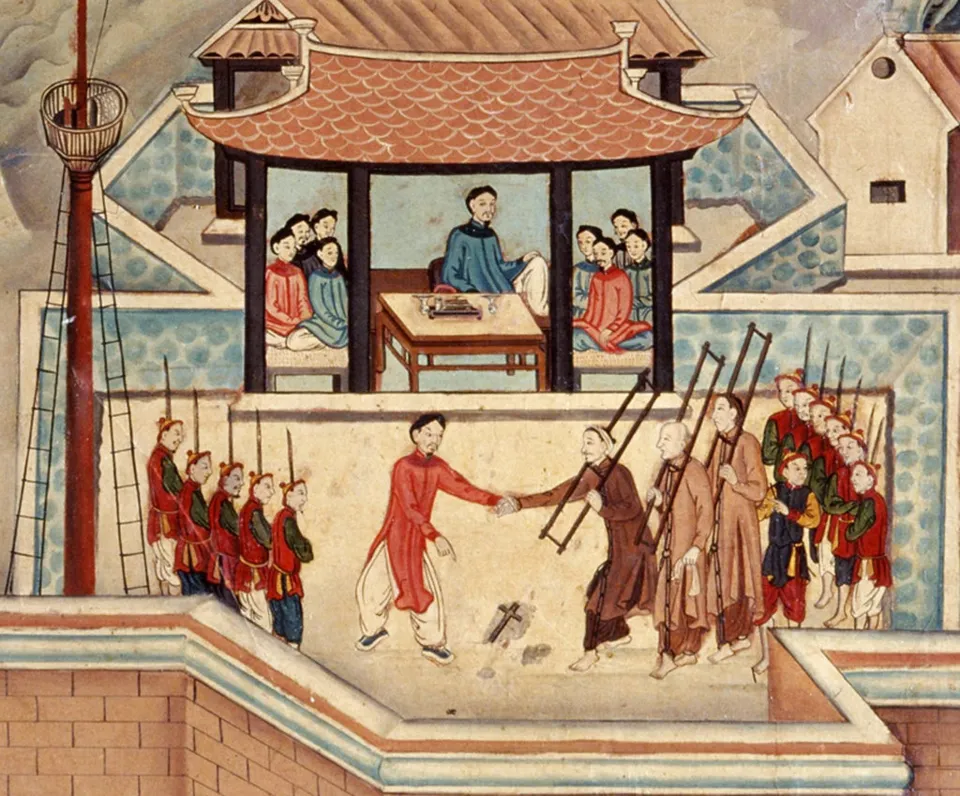
The Nguyễn Dynasty (1802–1945) transformed anti-Catholic sentiment into a coordinated state apparatus of suppression, a pivotal moment in the history of Vietnamese Catholicism.
Minh Mạng (1820–1841) initiated a legal framework that classified Catholicism as a “heterodox” (tả đạo) foreign sect threatening Confucian social order. The imperial government viewed Catholic allegiance to the Pope as incompatible with loyalty to the Vietnamese throne, while the refusal to practice ancestor worship was deemed a direct assault on fundamental family and state rituals. This ideological fusion of political control and cultural purity justified what became one of the 19th century’s most systematic campaigns of religious persecution.
Minh Mạng’s 1820s Crackdown: The First Systematic Edicts
Minh Mạng’s reign marked the definitive turning point. Beginning in the early 1820s, he issued a series of explicit decrees that criminalized Catholic conversion, sacramental practice, and missionary activity. The 1825 edict ordered all foreign missionaries to depart and demanded that Vietnamese Catholics abandon their faith or face execution.
A subsequent 1833–1835 wave of edicts intensified penalties, mandating that local officials actively hunt down believers and destroy churches. These laws did not merely prohibit practice; they required positive action—forced renunciation, public abjuration ceremonies, and the systematic eradication of Christian communities.
The legal machinery included special tribunals, informant networks, and collective responsibility clauses that punished entire families for one member’s faith. This was not sporadic violence but a calculated legal strategy to eliminate Catholicism within one generation through terror and forced assimilation.
Branding “Tả Đạo”: Marking Catholics for Social Ostracism
Beyond capital punishment, the Nguyễn state devised a permanent mark of infamy: facial branding. Catholics captured or forced to apostatize were branded on the face with the characters “tả đạo” (左道), meaning “heterodox path” or “leftist/evil way.” This practice served multiple state objectives. First, it created a visible, permanent identifier that prevented reintegration into mainstream society—a branded person could never fully escape their Catholic past.
Second, it weaponized social shame, turning the individual into a walking warning to others. Third, it legally codified discrimination; branded persons faced restricted employment, marriage prospects, and property rights.
The branding iron, often applied to the forehead or cheek, was a tool of psychological warfare as much as physical punishment, ensuring that even those who survived persecution carried lifelong scars of state condemnation. This method underscored the regime’s determination to eradicate not just the religion but its social memory.
Escalation Under Thiệu Trị and Tự Đức: From Edicts to Violence
Minh Mạng’s successors, Thiệu Trị (r. 1841–1847) and Tự Đức (r. 1847–1883), did not moderate but intensified the persecution.
While Minh Mạng’s early edicts focused on legal prohibition and forced conversion, the later reigns saw the systematic deployment of military force against Christian villages. Local mandarins, under pressure to meet quotas of apostates or executions, launched violent crackdowns that often exceeded imperial directives in brutality. The late 1840s to the 1850s witnessed large-scale military campaigns in regions with high Catholic concentrations, such as the provinces of Quảng Trị, Quảng Bình, and Bình Định.
Entire villages were surrounded, populations massacred, and churches razed. The escalation was continuous: what began as targeted executions of priests and catechists evolved into collective punishment of whole communities. This three-decade intensification (1820s–1850s) ensured that no Catholic family could assume safety, creating a climate of perpetual terror that drove believers into hiding or flight.
Scale and Methods: The Brutal Reality of Martyrdom
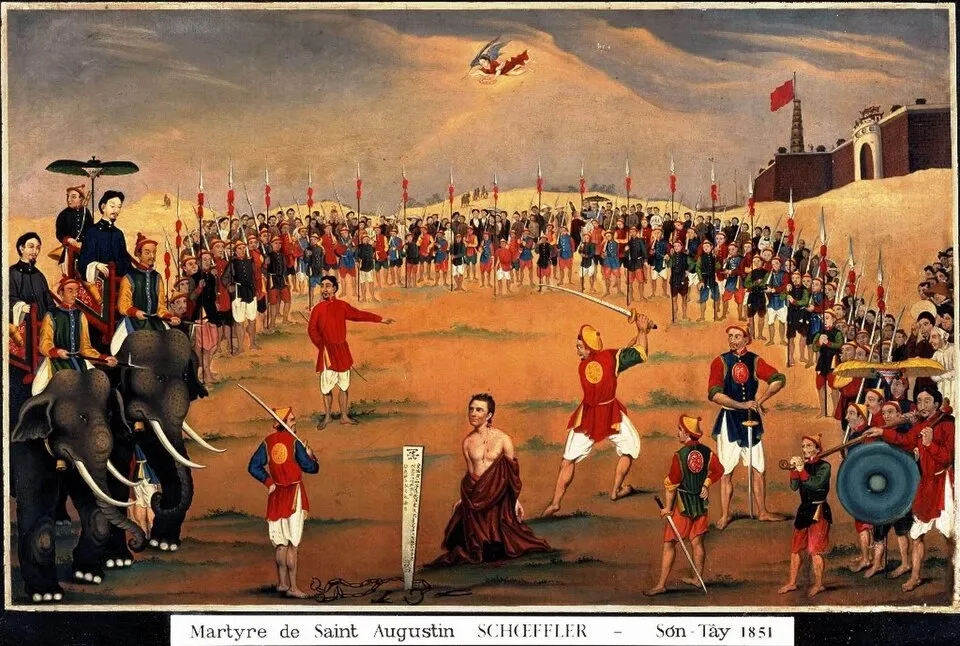
The machinery of persecution translated ideology into staggering human cost. The Nguyễn Dynasty’s campaign was not merely punitive but genocidal in its intent and effect, targeting the very existence of a religious minority. The methods were deliberately cruel, designed to maximize fear and deter adherence through public spectacle.
The scale of killing—exceeding 100,000 over seven decades—reflects a sustained, state-directed effort that depopulated entire regions of believers. Yet behind this aggregate number lie individual stories of extraordinary courage, as the Church later recognized in its formal canonization process.
Over 100,000 Deaths: The Demographic Catastrophe
Historical estimates place the total number of Vietnamese Catholics killed during the Nguyễn persecution waves between 1789 and 1861 at over 100,000. This figure encompasses executions, massacres, and deaths from forced labor, starvation in hiding, or punitive village burnings. The time span includes the late Tây Sơn period but the vast majority of deaths occurred under Nguyễn rule, particularly after 1820 — Catholic Bishops' Conference of Vietnam.
While the canonized represent a small fraction of the total, their diversity—spanning social classes, ages, and regions—testifies to the indiscriminate nature of the killing. The 117 martyrs, beatified earlier by Pope Pius X in 1909 and canonized by Pope John Paul II in 1988, serve as the official Church’s acknowledgment of a much broader, unnamed host of witnesses, with their historical context and selection for canonization reflecting the breadth of persecution.
While the canonized represent a small fraction of the total, their diversity—spanning social classes, ages, and regions—testifies to the indiscriminate nature of the killing. The 117 martyrs, beatified earlier by Pope Pius X in 1909 and canonized by Pope John Paul II in 1988, serve as the official Church’s acknowledgment of a much broader, unnamed host of witnesses.
Execution Methods: Decapitation, Strangulation, and Burning Alive
The Nguyễn state employed execution methods chosen for their terror value and symbolic rejection of Christian beliefs. The preferred techniques were:
| Method | Description | Context |
|---|---|---|
| Decapitation | Public beheading, often at town gates or market squares. The severed head was displayed on a pike as a warning. | Used for priests, catechists, and community leaders to maximize public deterrence. |
| Strangulation | Death by garrote or rope, sometimes after torture. Considered less honorable than beheading but still state-sanctioned. | Frequently applied to noble-born converts or women to avoid the “honor” of beheading reserved for commoners. |
| Burning Alive | Victims were bound and thrown into pyres, sometimes entire families or village groups together. | Reserved for the “most obstinate” believers or as collective punishment; denied Christian burial and symbolized damnation. |
These methods were not random but calibrated: decapitation offered a swift, public spectacle; strangulation allowed a slower death while preserving the body somewhat; burning alive inflicted maximum pain and destroyed the body completely, preventing Christian burial rites. The choice of method communicated the state’s judgment: some criminals were executed, others were “annihilated” in a manner that echoed damnation. Public display of corpses or body parts extended the terror beyond the moment of death, turning execution sites into landscapes of fear that haunted surviving communities.
Village Destructions and Property Confiscation
The persecution extended beyond individual executions to the economic and social annihilation of Catholic communities. Nguyễn troops and local militias systematically razed Christian villages, burning homes, churches, and community stores. Landholdings were confiscated and redistributed to loyalists or state agencies, stripping families of their livelihood and generational wealth.
Property seizure included not just physical assets but legal titles, rendering survivors landless and legally vulnerable. This collective punishment served two purposes: it destroyed the material base that sustained clandestine worship (no church, no community gathering place) and it created a refugee crisis that dispersed believers, making them harder to organize. The destruction of villages forced Catholics into the jungles and mountains, where they lived as fugitives.
This displacement directly contributed to the formation of hidden communities and the legend of La Vang, where persecuted believers gathered in the Quảng Trị wilderness. The economic warfare complemented the physical violence, ensuring that even those who escaped execution faced a life of destitution and constant movement.
Consequences: French Intervention and the La Vang Legacy
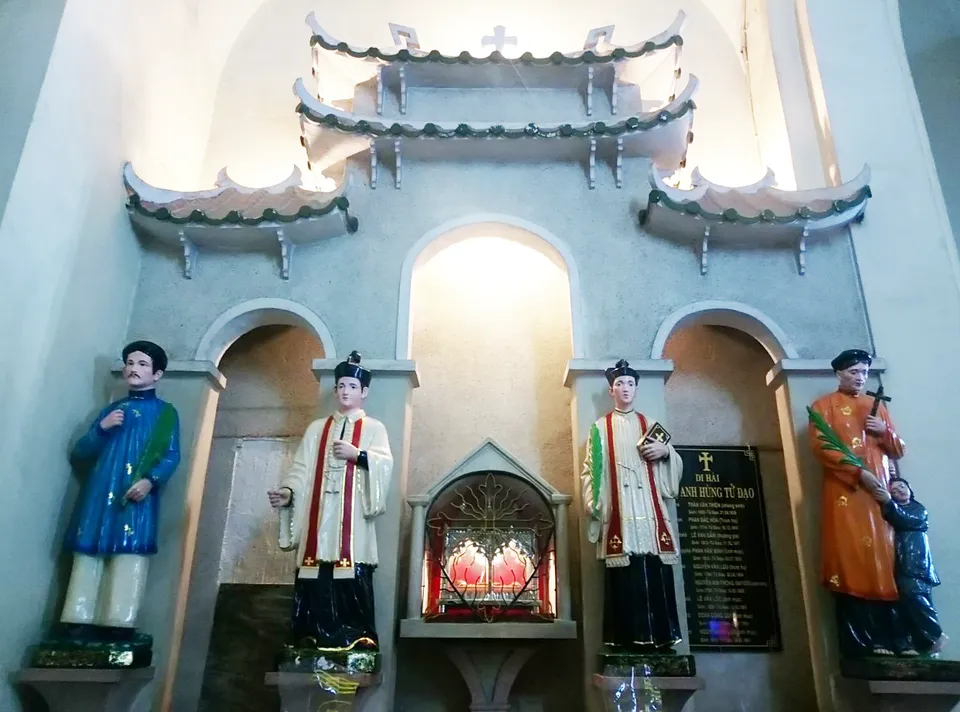
The Nguyễn Dynasty’s persecution did not occur in isolation; it became a catalyst for international intervention that reshaped Vietnam’s destiny. Simultaneously, the very suffering inflicted by the state forged a powerful spiritual symbol that endures in Vietnamese Catholic identity. The consequences were thus twofold: the loss of national sovereignty and the birth of a martyrology that sanctified resistance.
Pretext for Colonization: How Persecution Invited French Forces
By the 1850s, reports of Nguyễn persecution—particularly the 1856 execution of a Spanish missionary and the 1857 destruction of churches—provided the French Second Empire under Napoleon III with a humanitarian pretext for military intervention. France, already possessing treaty rights to protect Catholics in Asia under the 1842 Treaty of Whampoa, framed its 1858–1862 Cochinchina campaign as a mission to rescue persecuted Christians. The capture of Đà Nẵng in 1858 and the subsequent seizure of Saigon in 1859 were publicly justified as responses to Nguyễn “barbarity” against Catholics.
While imperial ambitions and trade interests drove French expansion, the persecution narrative was indispensable for domestic French support and for masking outright conquest as moral intervention. The Nguyễn court’s refusal to cede territory and its continued repression only hardened French resolve.
By 1862, the Treaty of Saigon forced the cession of three southern provinces, marking the beginning of French Indochina. The persecution thus achieved the opposite of its goal: it invited foreign domination that dismantled the Nguyễn state’s independence within decades.
La Vang Apparition: Persecution’s Spiritual Legacy
In 1798, during the early Nguyễn consolidation, thousands of Catholics fled into the remote jungle of Quảng Trị to escape Minh Mạng’s forces. In this wilderness, they reported an apparition of the Virgin Mary, dressed in simple Vietnamese áo dài, holding the Child Jesus, accompanied by two angels. Mary consoled them, promised to intercede for their return to their homeland, and instructed them to use leaves from the surrounding trees for medicinal purposes.
This event, known as the La Vang apparition, transformed a site of suffering into the most revered Marian shrine in Vietnam. The faithful returned after the persecution eased and built a modest chapel, which evolved into the grand Basilica of La Vang today. The shrine’s significance lies in its organic emergence from the people’s experience—not a top-down institution but a grassroots response to trauma.
La Vang became a symbol of hope, resilience, and the belief that divine solidarity accompanies persecution. Its very existence, born in the jungle refuge, embodies how state violence inadvertently sanctified space and created a national pilgrimage site that draws millions annually, including non-Catholics. The apparition narrative reframes persecution from mere victimhood to a story of divine accompaniment and cultural adaptation, as Mary appeared in Vietnamese dress, speaking to a people in exile.