Bishop Joseph Huỳnh Văn Sỹ has led the Diocese of Nha Trang since his appointment by Pope Francis on May 1, 2023. This coastal diocese in Vietnam’s South Central Coast faces unique pastoral challenges where tourism and fishing shape every aspect of ministry.
The bishops of Nha Trang have developed innovative strategies to serve both traditional fishing communities and the influx of tourists, blending spiritual care with social outreach and environmental stewardship. Understanding the leadership and ministry of Vietnamese bishops in this region provides insight into how the Catholic Church adapts to dynamic coastal environments worldwide.
- Bishop Joseph Huỳnh Văn Sỹ was appointed by Pope Francis on May 1, 2023, bringing fresh leadership to the coastal diocese.
- The Diocese of Nha Trang covers 9,486 km² across Khánh Hòa and Ninh Thuận provinces, serving both fishing communities and tourist populations with innovative pastoral strategies.
- Nha Trang’s bishops blend spiritual care with social outreach, environmental stewardship, and sustainable development, modeling coastal ministry for the global church.
Current and Past Bishops of Nha Trang Diocese

Bishop Joseph Huỳnh Văn Sỹ: Leadership Since 2023
Bishop Joseph Huỳnh Văn Sỹ assumed leadership of the Diocese of Nha Trang on May 1, 2023, following his appointment by Pope Francis. He brings fresh energy to a diocese with a rich episcopal lineage, succeeding Bishop Joseph Võ Ðức Minh who served from 2009 to 2023. Bishop Sỹ’s vision continues the diocese’s commitment to coastal ministry, emphasizing evangelization among tourists and support for fishing families along the South Central Coast.
His appointment reflects the Vatican’s confidence in his ability to shepherd a community that balances traditional livelihoods with rapid tourism development. Under his leadership, the diocese maintains its focus on integrating spiritual formation with practical social services, particularly in districts like Cam Lam where poverty remains a challenge.
Episcopal Succession: From Bishop Thuận to Bishop Minh
The following table outlines the episcopal succession of Nha Trang’s recent bishops, highlighting their tenures and historical contexts:
| Bishop | Tenure | Notable Contributions & Context |
|---|---|---|
| François-Xavier Nguyễn Văn Thuận | 1967–1975 | Later became Cardinal; renowned for his faith witness during imprisonment; served during the Vietnam War period |
| Paul Nguyễn Văn Hoà | 1975–2009 | Longest-serving bishop; guided the diocese through post-war reconstruction and reunification era; oversaw significant parish growth |
| Joseph Võ Ðức Minh | 2009–2023 | Navigated rapid tourism expansion; strengthened Caritas social programs; prepared diocese for 21st-century challenges |
| Joseph Huỳnh Văn Sỹ | 2023–present | Current bishop; emphasizes innovative coastal ministry and environmental stewardship; appointed by Pope Francis |
This succession demonstrates continuity in leadership while adapting to changing circumstances in coastal Vietnam.
The Diocese of Nha Trang: Establishment and Jurisdiction
The Diocese of Nha Trang was erected in its present form on November 24, 1960, during the period when the Catholic Church in South Vietnam was reorganizing its diocesan structure. However, Catholic presence in the region stretches back centuries, with early missionaries establishing communities along the coast long before the formal diocese was created. The diocese covers 9,486 square kilometers across two provinces: Khánh Hòa and Ninh Thuận.
This vast territory includes Nha Trang city, Cam Ranh, Ninh Hòa, Diên Khánh, and numerous coastal districts. As part of the Ecclesiastical Province of Huế, the diocese maintains close ties with the broader Vietnamese Catholic hierarchy. For more information about the national church structure, see the Catholic Bishops’ Conference of Vietnam.
Coastal Ministry: Serving Fishermen and Tourists
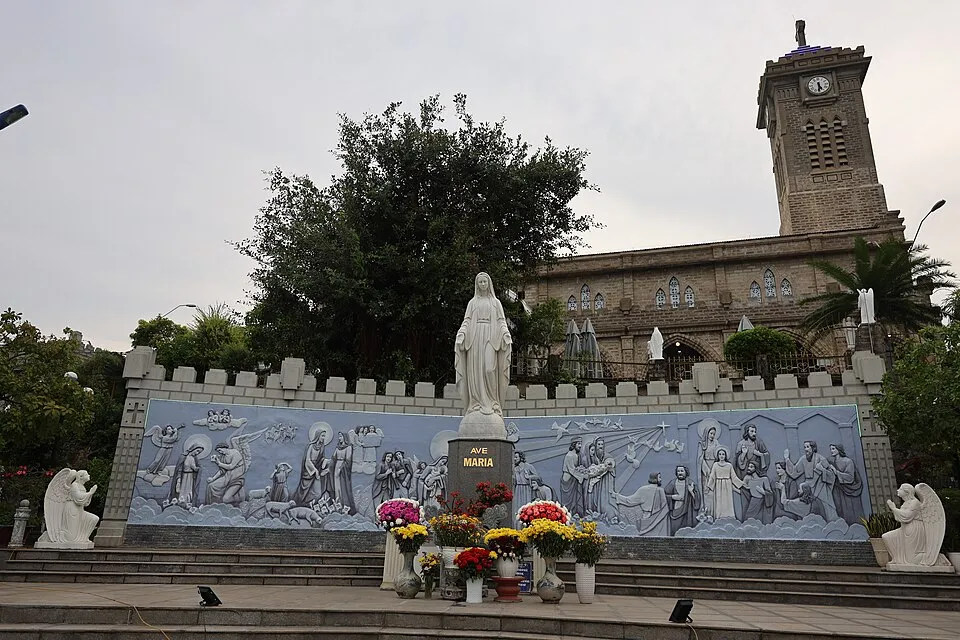
Geographic Scope: 9,486 km² Across Two Provinces
The Diocese of Nha Trang occupies a strategic position on Vietnam’s South Central Coast, where the South China Sea meets a dramatic landscape of mountains and beaches. This geography defines the diocese’s economic and pastoral reality. Tourism, fishing, and farming form the essential triad of local livelihoods.
Nha Trang city has emerged as one of Vietnam’s premier beach destinations, attracting domestic and international visitors to its famous shores like Mỹ Khê Beach and the Vinpearl resort complex. The diocese extends from Cam Ranh Bay in the south to the arid coastal plains of Ninh Thuận, encompassing diverse communities from the fishing villages of Xóm Bóng Đèn to the highland parishes near Hon Chong. This dual identity—as both a historic fishing region and bustling tourist hub—shapes every aspect of diocesan ministry.
Pastoral Strategies for Tourism and Fishing Communities
The bishops of Nha Trang have developed innovative pastoral strategies to address the unique needs of both fishing communities and tourists:
- Mobile Ministry for Fishermen: Priests and catechists travel on boats to reach fishing families at sea or in remote coastal villages, bringing sacraments and spiritual support to those who cannot attend parish churches.
- Multilingual Liturgies for Tourists: Parishes near major resorts and beaches offer Masses in English, Korean, Chinese, and Russian to serve the international tourist population, particularly during peak seasons from December to April.
- Beach Evangelization Events: The diocese organizes open-air prayer gatherings and faith-sharing sessions on public beaches like Nha Trang Beach, making the Catholic message accessible to casual visitors.
- Hotel Chaplaincy Partnerships: Collaboration with major hotels and resorts provides guest chaplains and prayer resources for Catholic tourists, with information kiosks at Nha Trang’s main tourist centers.
- Integrated Social Outreach: Diocesan Caritas coordinates food aid—particularly rice distributions—scholarships for children from fishing families, and housing projects in rural districts like Cam Lam, serving all regardless of religion.
- Environmental Education: Parishes incorporate care for creation into religious education, addressing issues like marine pollution and sustainable fishing practices that directly affect coastal communities.
- Cultural Integration: Catholic festivals are sometimes adapted to include local coastal traditions, creating bridges between faith and cultural identity.
These approaches transform the challenges of a tourist diocese into opportunities for evangelization and service.
Environmental Stewardship and Sustainable Development
Environmental stewardship has become a cornerstone of pastoral strategy in Nha Trang, reflecting the bishops’ recognition that coastal communities face existential threats from climate change, marine degradation, and overfishing. The diocese integrates ecological concerns into its social outreach, supporting sustainable fishing initiatives that help local families maintain livelihoods without depleting resources. Parishes near vulnerable coastal areas participate in mangrove restoration projects and climate resilience programs.
This focus on sustainable development serves as a model for coastal ministry worldwide, demonstrating how spiritual leadership can address practical environmental challenges. The bishops frame environmental care as both a moral imperative and a practical necessity for communities whose lives are tied to the sea. This integrated approach has drawn attention from the broader Vietnamese Catholic hierarchy as a template for other dioceses facing similar ecological pressures.
How Does the Diocese of Nha Trang Fit Within Vietnam’s Catholic Landscape?
What is the Catholic Bishops’ Conference of Vietnam?
The Catholic Bishops’ Conference of Vietnam (CBCV) serves as the official assembly of the Catholic hierarchy in the country, promoting communion and collaboration among all 27 dioceses. The conference includes all active and retired bishops—diocesan, coadjutor, and auxiliary—from Vietnam’s three archdioceses (Hanoi, Huế, and Saigon) and 24 suffragan dioceses.
Its origins trace to the 1960s when it was created for South Vietnam; after national reunification, it was officially re-founded in 1980. The CBCV coordinates pastoral initiatives, facilitates dialogue with government authorities, and addresses common challenges facing the Vietnamese Church.
The Diocese of Nha Trang participates actively in the conference, contributing its experience in coastal ministry and tourism evangelization to the broader national conversation. The CBCV maintains its headquarters in Hanoi and publishes regular communications through its Social Communications Committee.
Is Catholicism Strong in Vietnam? Statistics and Context
Vietnam’s Catholic Church represents one of Asia’s most significant Catholic communities, ranking fifth in size after the Philippines, India, China, and Indonesia. The following table presents key 2026 statistics:
| Metric | Data | Context |
|---|---|---|
| Asian Ranking | 5th largest | After Philippines, India, China, Indonesia |
| Catholic Population | ~7 million | 2026 estimate |
| Percentage of Population | 7.4% | Significant religious minority |
| Dioceses | 27 total (3 archdioceses) | Hanoi, Huế, Saigon are metropolitan sees |
| Parishes | 2,228 | Local church communities nationwide |
| Priests | 2,668 | Diocesan and religious clergy |
These figures reflect a vibrant church that has grown significantly since the re-establishment of the CBCV in 1980, despite historical challenges including the Vietnam War and post-war restrictions.
Nha Trang’s Role Among Vietnam’s 27 Dioceses
Frequently Asked Questions About Bishops Of Nha Trang Vietnam
What are the unspoken rules in Vietnam?
Most Vietnamese will avoid public displays that could compromise their reputation. As a general rule, keep your cool and avoid loud arguments, making a scene, berating others for mistakes, or pointing out anything that may cause the locals to feel shamed.
What are the unspoken rules in Vietnam?
Most Vietnamese will avoid public displays that could compromise their reputation. As a general rule, keep your cool and avoid loud arguments, making a scene, berating others for mistakes, or pointing out anything that may cause the locals to feel shamed.