Under Vietnam’s Nguyễn Dynasty (1802-1883), an estimated 130,000 to 300,000 Catholics were killed in one of the most severe persecutions in Church history. This state-sponsored campaign, driven by anti-Christian edicts from three successive emperors, targeted a faith viewed as a threat to imperial authority.
While the names of most victims are lost, 117 martyrs were canonized in 1988 by Pope John Paul II to represent this immense sacrifice. Their story is central to understanding the History of Vietnamese Catholicism.
- The Nguyễn Dynasty’s persecution (1802-1883) caused an estimated 130,000-300,000 Catholic deaths, making it one of the largest martyrdom events in Christian history.
- Three successive emperors—Minh Mạng, Thiệu Trị, and Tự Đức—issued anti-Christian edicts, viewing Catholicism as a security threat to their rule.
- In 1988, Pope John Paul II canonized 117 martyrs, representing the larger unnamed faithful who suffered extreme tortures during this period.
The Scale of Martyrdom: 130,000-300,000 Deaths Under the Nguyễn Dynasty
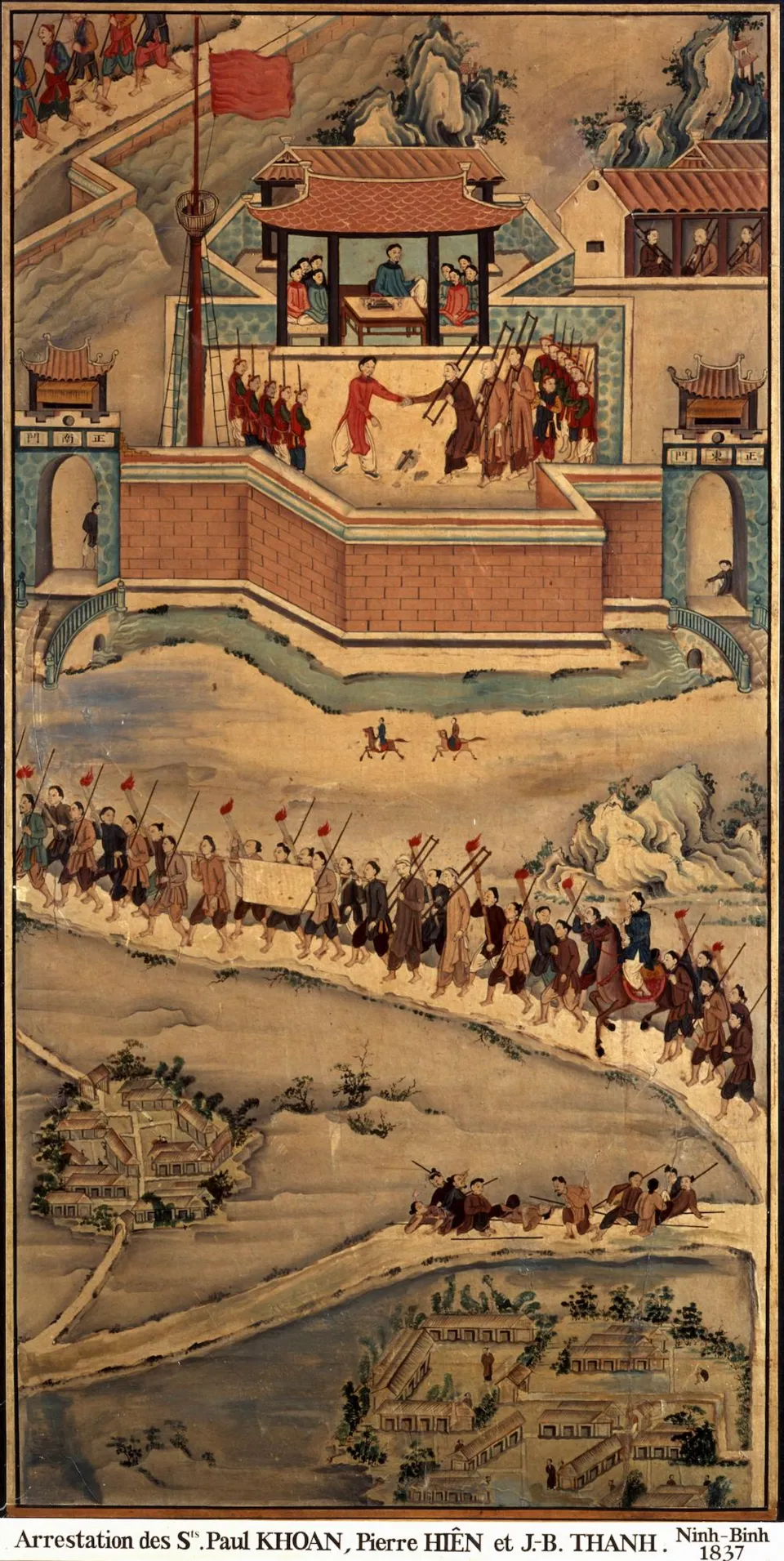
The persecution of Catholics under the Nguyễn Dynasty resulted in a staggering loss of life. The Vatican estimates the number of Vietnamese martyrs at between 130,000 and 300,000. This range reflects the difficulty of precise record-keeping during a period of widespread violence and chaos.
The scale places this persecution among the most extensive in Christian history, comparable only to the great persecutions of the early Church. The majority of these deaths occurred during the most intense phase of the campaign under the Nguyễn emperors, though the broader context of anti-Christian violence spans earlier dynasties as well.
Estimated Death Toll: 130,000 to 300,000 Catholics
- 130,000 to 300,000 deaths: The Vatican’s official estimate for the total number of Catholic martyrs in Vietnam.
- Why the range?: Historical records from the period are incomplete. Many deaths occurred in remote areas or were undocumented. The lower bound may represent confirmed deaths, while the upper bound includes those presumed dead from torture, imprisonment, or starvation.
- Historical comparison: This scale is comparable to the persecution under the Roman Empire before Constantine’s Edict of Milan in 313 AD, which also claimed hundreds of thousands of lives over centuries.
- Mostly unnamed: Only a tiny fraction of these martyrs have their names preserved in Church records.
The 117 canonized saints serve as representatives for this vast, anonymous host.
This immense number underscores the totality of the Nguyễn court’s campaign. It was not sporadic violence but a systematic effort to eradicate the faith from the kingdom.
The Nguyễn Dynasty Period: 1802-1883
The Nguyễn dynasty ruled unified Vietnam from 1802 to 1883. This 81-year period marks the most sustained and official persecution of Catholics. While individual martyrs died as early as 1745 and as late as 1862 (Source: Wikipedia/ICN), the imperial edicts and state machinery of repression were a hallmark of the Nguyễn era.
The dynasty began with Emperor Gia Long’s victory in 1802 and ended with the French protectorate treaties of 1883-1884. The persecution peaked in the mid-19th century under Emperors Minh Mạng, Thiệu Trị, and Tự Đức, before French military intervention altered the political landscape.
Why Catholicism Was Seen as a Security Threat
The Nguyễn emperors viewed Catholicism not merely as a religious deviation but as a direct threat to the political and social order. Their rationale stemmed from several core concerns:
- Foreign alliances: Catholic missionaries were predominantly European (French, Spanish, Portuguese). The court feared they could serve as fifth columnists, facilitating foreign invasion or colonization.
- Refusal of ancestor worship: The Catholic prohibition against worshipping ancestors and the Vietnamese emperor (seen as a semi-divine figure) was interpreted as an act of disloyalty and sedition. It undermined the Confucian social hierarchy that bound the kingdom together.
- Potential for rebellion: The tight-knit, transnational Catholic community, with its own hierarchy and foreign connections, was perceived as a state within a state—a potential nucleus for insurrection.
This “security threat” framing justified extreme measures in the eyes of the imperial court, leading to policies of eradication.
Composition of the Martyrs: Vietnamese and Foreign Missionaries
The 117 canonized martyrs represent the known individuals from this vast pool of suffering. Their composition reflects the international nature of the Catholic mission in Vietnam.
| Group | Nationality/Order | Number |
|---|---|---|
| Vietnamese Martyrs | Indigenous faithful, including catechists, mothers, and priests | 96 |
| Spanish Dominicans | Missionaries from the Dominican order | 11 |
| French MEP | Members of the Paris Foreign Missions Society (Missions Etrangères de Paris) | 10 |
This table shows a clear majority of 96 Vietnamese lay and clerical faithful, alongside 21 European missionaries, embodying the untold stories of lay faithful who formed the backbone of the Church. They were beatified in four separate groups between 1900 and 1951 before their collective canonization in 1988. These 117 are the named representatives of the 130,000-300,000 unnamed who perished.
The Three Nguyễn Emperors Who Ordered Anti-Christian Persecution
The Nguyễn Dynasty’s anti-Christian campaign, as explored in Nguyễn Dynasty Persecution, was not the act of a single ruler but a sustained, multi-generational policy enforced by three successive emperors. Their sequential reigns created an unbroken chain of persecution that lasted decades.
Minh Mạng, Thiệu Trị, Tự Đức: The Three Persecuting Emperors
Emperors Minh Mạng, Thiệu Trị, and Tự Đức each issued severe anti-Christian edicts. Minh Mạng (r. 1820-1841) initiated the most intense phase with a series of harsh decrees in the 1830s and 1840s.
His son, Thiệu Trị (r. 1841-1847), continued the policy. Tự Đức (r.
1847-1883), the last great Nguyễn emperor before French conquest, maintained the persecution with particular ferocity until his death. This continuity across three reigns demonstrates that the anti-Christian stance was a settled state policy, not a personal whim of one emperor.
The Rationale: Catholicism as a Threat to Nguyễn Authority
The court’s justification for persecution was consistent, rooted in the “security threat” concept:
- Political disloyalty: Refusal to participate in state-mandated ancestor worship was seen as rebellion against the emperor and the Confucian social order.
- Foreign entanglement: The presence of European missionaries and the Church’s allegiance to the Pope in Rome were viewed as compromising national sovereignty.
- Social subversion: The Catholic community’s separate identity and laws threatened the homogeneity and control the Nguyễn state demanded.
These reasons formed the ideological backbone of the imperial edicts, turning religious belief into a capital offense.
From Edicts to Enforcement: The Mechanism of Persecution
Imperial edicts were translated into action through a brutal enforcement apparatus. Local officials were tasked with identifying Catholics, often through informant networks. Arrests were followed by extreme tortures designed to force apostasy.
Methods included branding the face with the characters “tả đạo” (unorthodox religion), repeated beatings, and the “death by a thousand cuts.” Those who refused to renounce their faith were executed, often publicly, as a deterrent. Families and entire villages harboring Christians were obliterated—their homes destroyed and inhabitants killed or enslaved. The goal was total eradication through terror.
The Duration: Nearly Eight Decades of Imperial Campaign
The persecution under the Nguyễn Dynasty spanned the vast majority of its independent rule. From the first major edicts in the 1820s under Minh Mạng to the final years of Tự Đức’s reign in the early 1860s, the campaign lasted approximately 40 years of peak intensity.
The persecution under the Nguyễn Dynasty spanned the vast majority of its independent rule. From the first major edicts in the 1820s under Minh Mạng to the final years of Tự Đức’s reign in the early 1860s, as detailed in a chronology of faith across centuries, the campaign lasted approximately 40 years of peak intensity.
The Martyrs’ Legacy: Feast, Memory, and Global Veneration
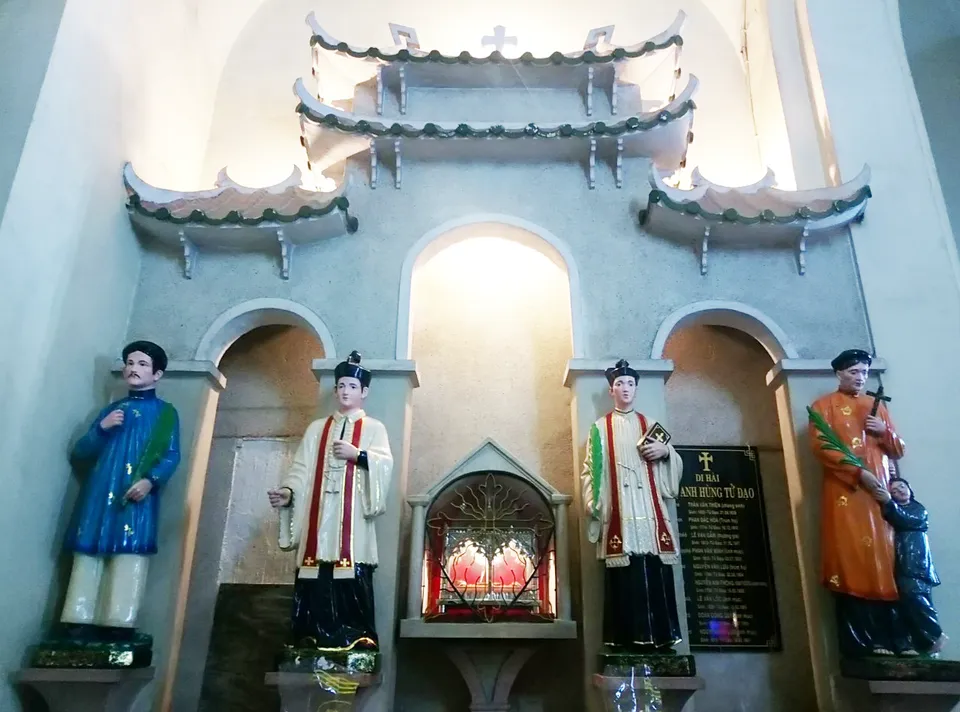
The sacrifice of the Vietnamese martyrs did not end with their deaths. Their memory was preserved by the surviving faithful and eventually honored by the universal Church, creating a powerful legacy of faith and resilience.
1988 Recognition: Pope John Paul II’s Acknowledgment
On June 19, 1988, Pope John Paul II canonized the 117 Vietnamese Martyrs, initiating their spiritual legacy and liturgical veneration in a grand ceremony at St. Peter’s Square. This act was the culmination of a lengthy beatification process that had begun in the early 20th century.
The canonization recognized both the named saints and, by extension, the hundreds of thousands of unnamed martyrs. It was a profound acknowledgment by the Church that the blood shed in Vietnam was a seed of faith for the global Catholic community. The event was attended by thousands of overseas Vietnamese, marking a significant moment in the diaspora’s identity.
Representing the Unnamed: The 117 as Symbols of Thousands
The 117 canonized saints are explicitly understood as representatives of the much larger group. In Catholic theology, canonization does not require that every individual be known; a representative sample can stand for a collective witness. This means the feast day on November 24 honors all who died for the faith in Vietnam between 1745 and 1862.
The canonization ensures that the scale of the persecution—130,000 to 300,000—is never forgotten, even if most names are lost to history. They are the “cloud of witnesses” (Hebrews 12:1) for the Vietnamese Church.
The 117 Martyrs: A Diverse Group of Vietnamese and Foreign Believers
The breakdown of the canonized group highlights the collaborative nature of the mission. As detailed in the table below, the vast majority were Vietnamese laity and clergy, demonstrating the rise of indigenous clergy and religious that fueled the Church’s growth. The European missionaries, though fewer in number, were the initial catalysts and leaders of the Church.
| Nationality/Group | Number | Role |
|---|---|---|
| Vietnamese | 96 | Catechists, priests, bishops, mothers, young people |
| Spanish Dominicans | 11 | Missionary priests |
| French (Paris Foreign Missions) | 10 | Missionary priests and bishops |
This diversity shows a Church truly Vietnamese and truly universal, united in witness across cultures.
Our Lady of La Vang: A Symbol of Hope During Persecution
During the darkest days of the Nguyễn persecution, a powerful symbol of hope emerged: Our Lady of La Vang (Source: PAA data). According to tradition, Catholics fleeing persecution in the early 19th century gathered in the forest of La Vang. There, the Blessed Virgin Mary appeared to them, comforting and encouraging them to persevere in their faith.
This Marian apparition, while not officially recognized by the Vatican, became a profound spiritual anchor for the martyrs and survivors. The La Vang Shrine remains a major pilgrimage site today, symbolizing God’s presence with a suffering people and the hope that ultimately triumphed over persecution.
The most surprising finding is the sheer scale: 130,000-300,000 deaths makes this one of the largest martyrdom events in Christian history. For a specific action, readers can learn more about the Vietnamese Martyrs’ feast day on November 24 and visit the official History of Vietnamese Catholicism page on the CBCV website for authoritative information.
Frequently Asked Questions About Martyrs Under Nguyễn Dynasty
Who are the Catholic Vietnamese martyrs?
117 canonized martyrs, comprising 96 Vietnamese faithful (catechists, priests, bishops, mothers, young people) and 21 European missionaries (11 Spanish Dominicans, 10 French Paris Foreign Missions priests and bishops), canonized in 1988.
What is the Vietnamese version of the Virgin Mary?
Our Lady of La Vang is a title of the Blessed Virgin Mary associated with a purported apparition during the anti-Christian persecutions under the Nguyễn dynasty, forming part of the martyrs' legacy and global veneration.