This list of dioceses in Vietnam provides the most current 2026 reference for all 27 Catholic dioceses, including their boundaries, hierarchical structure, and key statistics. Vietnam’s Catholic Church is organized into three ecclesiastical provinces—Hanoi in the north, Hue in the central region, and Ho Chi Minh City in the south—each led by a metropolitan archdiocese.
The Catholic Bishops’ Conference of Vietnam (CBCV) coordinates the activities of all dioceses, fostering communion and pastoral collaboration. Below is the complete, up-to-date enumeration of every diocese, their suffragan relationships, and aggregate data on membership, clergy, and seminarians.
- Vietnam’s Catholic Church consists of 27 dioceses grouped under three ecclesiastical provinces: Hanoi, Hue, and Ho Chi Minh City.
- As of 2026, the Church serves over 7 million Catholics, with approximately 30,000 clergy and 11,713 seminarians in 8 regional seminaries.
- The Catholic Bishops’ Conference of Vietnam (CBCV) is the official assembly uniting all 27 dioceses to promote communion and pastoral collaboration.
The 27 Dioceses of Vietnam: Complete List by Ecclesiastical Province
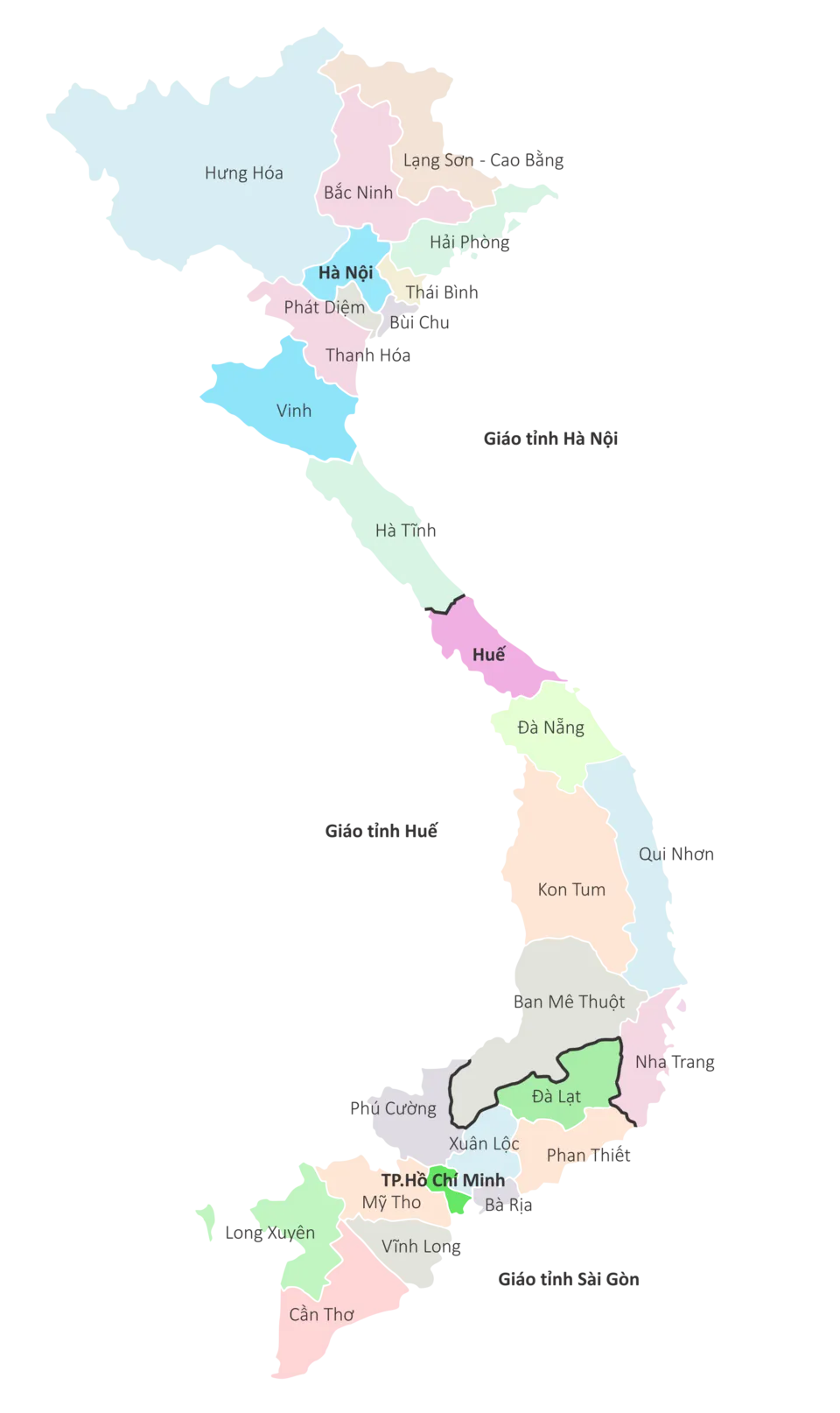
Vietnam’s 27 Catholic dioceses are organized into three ecclesiastical provinces, each headed by a metropolitan archdiocese. This structure, established in 1960 and reorganized in 1980, ensures effective pastoral governance across the country.
Below is the complete list of dioceses within each province, including their official names and territorial coverage. For a visual representation of how these provinces cover Vietnam’s geography, see the Vietnam dioceses map.
Ecclesiastical Province of Hanoi
The Ecclesiastical Province of Hanoi covers the northern region of Vietnam and comprises 10 dioceses: the Metropolitan Archdiocese of Hanoi and nine suffragan dioceses.
- Metropolitan Archdiocese of Hanoi
- Diocese of Bắc Ninh
- Diocese of Bùi Chu
- Diocese of Lạng Sơn
- Diocese of Hải Phòng
- Diocese of Hưng Hóa
- Diocese of Thái Bình
- Diocese of Phát Diệm
- Diocese of Thanh Hóa
- Diocese of Vinh
These northern dioceses serve a significant portion of Vietnam’s Catholic population, with historic centers such as Hanoi and Bắc Ninh dating back to the early missionary period. The province encompasses the Red River Delta and extends to border regions, including some of the oldest Christian communities in the country. The Archdiocese of Hanoi itself traces its origins to the 17th century and remains a spiritual and administrative hub for the north.
Ecclesiastical Province of Hue
The Ecclesiastical Province of Hue is located in central Vietnam and consists of 7 dioceses: the Metropolitan Archdiocese of Hue and six suffragan dioceses.
- Metropolitan Archdiocese of Hue
- Diocese of Đà Nẵng
- Diocese of Ban Mê Thuột
- Diocese of Hà Tĩnh
- Diocese of Kon Tum
- Diocese of Nha Trang
- Diocese of Quy Nhơn
The central region presents a unique cultural landscape, with a mix of urban coastal cities and remote mountain areas. The Archdiocese of Hue holds a special place in Vietnamese Catholic history, as it is associated with the apparitions of Our Lady of La Vang. The suffragan dioceses of Đà Nẵng and Nha Trang are major population centers, while Ban Mê Thuột and Kon Tum serve the Central Highlands, where many ethnic minorities reside.
This province demonstrates the Church’s commitment to inculturation and evangelization across diverse cultures. The geographical distribution across these dioceses is further detailed in Vietnam Dioceses: A Geographical Overview.
Ecclesiastical Province of Ho Chi Minh City
The Ecclesiastical Province of Ho Chi Minh City covers the southern region of Vietnam and includes 10 dioceses: the Metropolitan Archdiocese of Ho Chi Minh City and nine suffragan dioceses.
- Metropolitan Archdiocese of Ho Chi Minh City
- Diocese of Bà Rịa
- Diocese of Cần Thơ
- Diocese of Đà Lạt
- Diocese of Long Xuyên
- Diocese of Mỹ Tho
- Diocese of Phan Thiết
- Diocese of Phú Cường
- Diocese of Vĩnh Long
- Diocese of Xuân Lộc
This southern province is the most populous, with the Archdiocese of Ho Chi Minh City as the largest Catholic see. The dioceses cover the Mekong Delta, the southeast, and the central southern coast, serving a vibrant Catholic community with numerous parishes and religious institutions. The Archdiocese of Ho Chi Minh City, with its famous Notre-Dame Cathedral, is a spiritual hub.
The suffragan dioceses include Bà Rịa, which encompasses the coastal areas; Cần Thơ and Vĩnh Long in the Mekong Delta; Đà Lạt, a highland city known for its seminary; and Phú Cường, one of the newer dioceses. This province reflects the dynamic growth of the Church in Vietnam’s south. Each diocese maintains its own cathedral, and for a detailed exploration of these sacred buildings, see Cathedrals of Vietnam Dioceses.
Statistical Profile of the Catholic Church in Vietnam in 2026
Beyond the structural organization, the Catholic Church in Vietnam demonstrates robust vitality through its membership, clergy, and vocations. The following statistics, current as of 2026, illustrate the scale and growth of the Church across the 27 dioceses.
Total Catholic Population and Clergy: Over 7 Million Faithful and 30,000 Clergy
The total of over 3,400 parishes—locatable via the Catholic Directory Vietnam—means an average of about 125 parishes per diocese, though distribution varies between urban and rural areas.
| Metric | 2026 Figure |
|---|---|
| Catholic Population | Over 7 million |
| Total Clergy | Approximately 30,000 (priests, religious brothers and sisters) |
| Parishes | Over 3,400 |
These numbers reflect a Church that serves roughly 7.4% of Vietnam’s total population. The clergy-to-faithful ratio indicates a relatively well-staffed pastoral outreach, with priests and religious serving across the 27 dioceses.
The total of over 3,400 parishes means an average of about 125 parishes per diocese, though distribution varies between urban and rural areas. The figure of 30,000 clergy includes diocesan priests, members of religious orders, and those in formation, highlighting the Church’s extensive ministerial network.
Seminaries and Vocations: 8 Regional Seminaries with 11,713 Seminarians
A striking indicator of the Church’s vitality is the number of seminarians pursuing priestly formation. Vietnam’s 8 regional major seminaries accommodate 11,713 seminarians from 26 of the 27 dioceses, reflecting strong vocations and a promising future for the clergy.
- 8 major seminaries provide theological and philosophical education across the country.
- 11,713 seminarians are currently in formation, a number that has grown steadily over the past decade.
- These seminarians represent 26 of the 27 dioceses, indicating near-universal participation in priestly formation.
- The seminaries are distributed regionally to serve candidates from different ecclesiastical provinces.
- The formation programs combine spiritual, academic, and pastoral training to prepare priests for ministry in Vietnam.
This robust vocations pipeline counters any perception of a clergy shortage. With over 11,000 seminarians, the Church ensures a steady supply of new priests to serve the growing Catholic community. The fact that 26 dioceses send candidates to these seminaries underscores the shared commitment to priestly formation across the ecclesiastical provinces.
Growth Trend: Catholic Population Increase from Pre-1945 to 2026
The historical trajectory of the Catholic Church in Vietnam shows remarkable growth. Before 1945, the Church served less than 2 million Catholics across 12 dioceses. By 2026, that number has nearly quadrupled to over 7 million faithful, and the number of dioceses has more than doubled to 27.
This expansion reflects both natural population growth and effective evangelization over the past eight decades. The increase from 12 to 27 dioceses demonstrates the Church’s adaptation to demographic changes and the need for more localized pastoral care.
Such growth is exceptional in Asia and highlights the enduring appeal of the Catholic faith in Vietnam. The historical reasoning behind the specific number of 27 dioceses is explored in 27 Dioceses Vietnam.
The Catholic Bishops’ Conference of Vietnam (CBCV): Unifying Body for All Dioceses
The Catholic Bishops’ Conference of Vietnam (CBCV) is the official assembly that brings together all 27 diocesan bishops to foster communion, coordinate pastoral initiatives, and represent the Church in dialogue with the state. As the central governing body, the CBCV plays a crucial role in unifying the diverse dioceses under a common mission.
CBCV as the Official Assembly Representing All 27 Dioceses
According to its statutes, the CBCV is the episcopal conference recognized by both the Holy See and the Vietnamese government. It includes all active and retired bishops of the 27 dioceses, ensuring that every part of the Church has a voice in collective decision-making. The Conference operates according to Catholic canon law and the norms of the Vietnamese state, balancing ecclesial autonomy with legal compliance.
Its presidency rotates among the bishops, and it maintains a secretariat to coordinate daily activities. The CBCV’s legitimacy as the sole representative body of the Catholic Church in Vietnam is acknowledged at the national level, allowing it to engage in official dialogues on religious affairs. For more information about the Conference’s structure and functions, visit the Catholic Bishops’ Conference of Vietnam page.
Committees and Collaborative Initiatives for Evangelization and Charity
To carry out its mission, the CBCV establishes specialized committees that focus on key areas of Church life. These include committees on evangelization, education, charity and social action, youth ministry, and liturgical renewal. Each committee brings together experts and diocesan representatives to develop common programs, share resources, and provide guidance to the dioceses.
For example, the Committee on Evangelization produces catechetical materials used nationwide, while the Charity Committee coordinates relief efforts during natural disasters. By fostering collaboration, the CBCV amplifies the impact of individual dioceses and ensures a unified response to the spiritual and social needs of Vietnamese Catholics.
Religious Freedom Context: Catholicism Operates Openly Under State Oversight
Vietnam’s legal framework guarantees the right to practice one’s religion, and the Catholic Church operates openly in most of the country. While the state regulates religious activities through the Law on Belief and Religion, requiring registration for certain activities, the Church is able to conduct worship, education, and charitable work with relative freedom.
The CBCV maintains a constructive relationship with the Government Committee for Religious Affairs, allowing the Church to navigate the regulatory environment while focusing on its spiritual mission. This context of regulated openness is typical for recognized religions in Vietnam and enables the Catholic Church to thrive and grow.
One of the most surprising facts about Vietnam’s Catholic Church is the dramatic expansion of its diocesan structure: from just 12 dioceses before 1945 to 27 today, more than doubling its territorial organization. Coupled with this growth is the impressive number of 11,713 seminarians in formation, which signals a vibrant future for the Church in Vietnam. These statistics defy the global trend of declining vocations in many Western countries and highlight Vietnam as a hotspot of Catholic vitality.
For the most current information, including interactive maps and detailed diocesan profiles, visit the official website of the Catholic Bishops’ Conference of Vietnam at Catholic Bishops’ Conference of Vietnam. There you can access the 2026 statistical yearbook and explore each diocese’s boundaries, leadership, and pastoral activities.
Meta Description: Explore the complete 2026 list of Catholic dioceses in Vietnam. Find all 27 dioceses organized by ecclesiastical provinces with key statistics on population, clergy, and seminarians.
Slug: list-of-dioceses-in-vietnam
Tags: CBCV, Catholic-Hierarchy.org, GCatholic.org, Ecclesiastical Provinces, Archdioceses, Suffragan Dioceses
Keywords: list of dioceses in Vietnam, Vietnam dioceses, Catholic dioceses Vietnam, 27 dioceses Vietnam, ecclesiastical provinces Vietnam, Catholic Bishops’ Conference of Vietnam
Frequently Asked Questions About List Of Dioceses In Vietnam
Is Catholicism allowed in Vietnam?
Vietnam's ruling communist party does not tolerate political dissent and strictly controls all religions. Various Buddhist groups operate openly in relative freedom, as does the Roman Catholic Church in most of the country.
What country is 100% Catholic?
The country with the largest percentage of its population having membership in the church is Vatican City at 100%, followed by Timor-Leste at 97%. According to the World Christian Database, there are 1.279 billion Catholics worldwide as of 2026, which constitute 47.8% of 2.674 billion Christians.
Is the Catholic Church growing in Vietnam?
Before 1945, the number of Catholic believers was very small, less than 2 million in 12 dioceses throughout Vietnam. Currently, the number has grown to over 7 million believers in 27 dioceses across the country, with approximately 30,000 priests, men and women religious.
Are most Vietnamese Americans Catholic?
While Christians, primarily Roman Catholics, make up about 10% of Vietnam's population, they make up approximately 36% of the Vietnamese American population.
Is it illegal to be queer in Vietnam?
Vietnam is a relatively hassle-free destination for LGBTQIA+ travellers. In recent years, the country has made positive strides in recognising the role of the LGBTQIA+ community. Same-sex relationships and same-sex sexual acts are legal and a ban on same-sex marriages was lifted in January 2015.