Vietnamese Catholicism embodies a vibrant expression of Catholic cultural practices where faith permeates daily life like a continuous festival. This unique integration of Latin Church traditions with indigenous Vietnamese values creates a distinctive spiritual landscape where the sacred and secular intertwine seamlessly. For Vietnam’s approximately 7 million Catholics—representing about 7% of the nation’s population—religious identity is not confined to Sunday Mass but woven into the fabric of family routines, seasonal rhythms, and community celebrations.
Three everyday practices demonstrate how Catholicism becomes a lived cultural reality: home altars that blend ancestor veneration with Catholic worship, structured devotional rhythms centered on the rosary and sacraments, and feast day celebrations that transform homes into sacred spaces. These practices reveal a faith that is both deeply personal and vibrantly communal, offering a model of inculturation that respects tradition while embracing local identity.
- Home altars integrate ancestor veneration with Catholic worship, featuring Jesus at the center flanked by Mary and saints, adorned with incense, candles, flowers, and fruit, placed in solemn, clean, well-ventilated spaces away from noise.
- October is observed as Tháng Mân Côi (Marian month), emphasizing rosary prayer alongside daily practices like Eucharistic Adoration and Lenten chants (Ngam), reflecting deep Marian devotion centered on Our Lady of La Vang.
- Feast days transform homes into festive altars for patron saints, embodying a family and community-centered approach to faith, complemented by social charity through Caritas Vietnam.
Home Altars: Blending Ancestor Veneration with Catholic Devotion
Dual Altar System: Placement and Symbolic Meaning
- Two typical arrangements: Ancestor altars are placed either adjacent to or directly below the main altar of God, creating a spatial relationship that honors both traditions simultaneously. The adjacent placement allows parallel veneration, while the below arrangement visually subordinates ancestor respect to divine worship.
- Symbolic balance: This configuration reflects a deliberate harmony between filial piety towards ancestors and devotion to God, allowing families to fulfill cultural obligations without compromising Catholic doctrine. The arrangement acknowledges that honoring one’s lineage is not incompatible with worshiping the one true God.
- Cultural integration: The practice exemplifies how Vietnamese Catholics integrate Latin Church traditions with indigenous values, demonstrating the intersection of faith and culture while maintaining respect for heritage and adhering to Catholic teaching on ancestor veneration. This balance was developed over centuries of dialogue between missionaries and local communities.
- Theological significance: The altar of God occupies the primary spiritual position, often elevated or centered, while the ancestor altar acknowledges family lineage. This spatial hierarchy demonstrates that Catholic identity and cultural identity are not mutually exclusive but complementary aspects of a unified life.
- Historical development: This dual system emerged as a practical solution during the early missionary period when converts faced pressure to maintain traditional rites. The Church eventually recognized that these practices, when properly oriented, could express Christian virtues of respect and gratitude.
- Two typical arrangements: Ancestor altars are placed either adjacent to or directly below the main altar of God, creating a spatial relationship that honors both traditions simultaneously. The adjacent placement allows parallel veneration, while the below arrangement visually subordinates ancestor respect to divine worship.
-
Symbolic balance: This configuration reflects a deliberate harmony between filial piety towards ancestors and devotion to God, allowing families to fulfill cultural obligations without compromising Catholic doctrine.
The arrangement acknowledges that honoring one’s lineage is not incompatible with worshiping the one true God.
- Cultural integration: The practice exemplifies how Vietnamese Catholics integrate Latin Church traditions with indigenous values, maintaining respect for heritage while adhering to Catholic teaching on ancestor veneration. This balance was developed over centuries of dialogue between missionaries and local communities.
- Theological significance: The altar of God occupies the primary spiritual position, often elevated or centered, while the ancestor altar acknowledges family lineage. This spatial hierarchy demonstrates that Catholic identity and cultural identity are not mutually exclusive but complementary aspects of a unified life.
-
Historical development: This dual system emerged as a practical solution during the early missionary period when converts faced pressure to maintain traditional rites.
The Church eventually recognized that these practices, when properly oriented, could express Christian virtues of respect and gratitude.
Sacred Display: Central Jesus, Surrounding Saints, and Ritual Offerings
The altar of God serves as the spiritual heart of the Vietnamese Catholic home, featuring a statue of Jesus Christ at its center, flanked by images of the Virgin Mary and patron saints. This arrangement visually establishes Christ’s supreme authority while honoring the communion of saints, reflecting Catholic art in Vietnam that blends missionary and local elements. Common ritual items include incense, lamps, candles, flowers, and fruit, each carrying layered symbolism—incense represents prayers rising to heaven, candles signify Christ as light of the world, flowers symbolize purity and the fleeting nature of life, and fruit represents the fruits of the Holy Spirit and the offering of one’s labor.
The central placement of Jesus reflects the Catholic doctrine of Christ as the sole mediator, while Mary and saints serve as intercessors and spiritual models. Common ritual items include incense, lamps, candles, flowers, and fruit, each carrying layered symbolism—incense represents prayers rising to heaven, candles signify Christ as light of the world, flowers symbolize purity and the fleeting nature of life, and fruit represents the fruits of the Holy Spirit and the offering of one’s labor.
The altar’s placement follows specific guidelines: it must occupy a solemn, clean, and well-ventilated space, deliberately set apart from noisy or impure areas of the home. This often means positioning the altar in a living room corner or a dedicated prayer room, never facing a bathroom or kitchen. Families maintain the altar with daily care, replacing flowers, refilling incense, and ensuring candles burn steadily.
The environment should foster prayerful recollection, free from distractions. This careful curation transforms a simple corner into a sacred microcosm where divine presence dwells among the family, making the home a domestic church.
Devotional Rhythms: Rosary, Sacraments, and Seasonal Chants
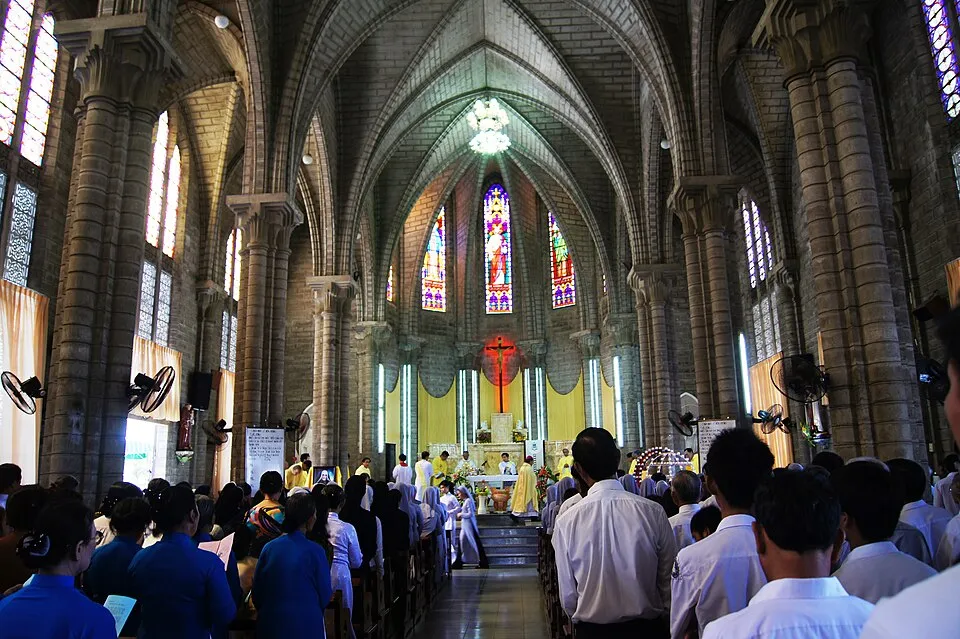
The Rosary and Marian Devotion: Daily Prayer and October’s Tháng Mân Côi
The rosary occupies a central place in Vietnamese Catholic spiritual life, prayed daily in countless households and parish communities. This devotion intensifies during October, observed nationwide as Tháng Mân Côi (Marian month), when families and parishes organize special rosary processions, novenas, and Marian hymns. The month-long emphasis reflects the profound significance of Our Lady of La Vang, Vietnam’s beloved Marian apparition, whose intercession is sought in both personal and communal prayers.
Historical records indicate that the apparition occurred in 1798 when Catholics fleeing persecution sought refuge in the La Vang forest, and Mary appeared comforted them. This narrative of suffering and consolation resonates deeply with Vietnamese Catholics’ historical experience.
The rosary’s meditative nature aligns perfectly with Vietnamese appreciation for contemplative practice, making it a bridge between global Catholic tradition and local spiritual temperament. During Tháng Mân Côi, parishes often hold evening rosary prayers in the churchyard, creating a visible witness of faith. Families may set up temporary altars with Marian images and candles, reciting the rosary together after dinner.
The practice fosters intergenerational bonding as grandparents teach grandchildren the prayers. The rosary beads themselves become cherished objects, sometimes passed down as family heirlooms. This rhythmic dedication to Mary shapes the Catholic cultural calendar, creating predictable spiritual patterns that anchor families in faith throughout the year.
Other Devotional Practices: Eucharistic Adoration, Mass, and Lenten Ngam Chants
- Eucharistic Adoration: Sustained prayer before the Blessed Sacrament represents a growing devotion, with many parishes offering continuous adoration chapels where individuals spend quiet time in Christ’s presence. This practice emphasizes the real presence of Christ in the Eucharist and provides a peaceful counterpoint to the busyness of daily life. In Vietnamese context, adoration often includes silent meditation and occasional chanting of Eucharistic hymns in the local language.
- Mass attendance: Weekly Sunday Mass remains non-negotiable for practicing Catholics, while feast days and holy days of obligation draw larger congregations for celebrations that often incorporate Vietnamese music and customs. The Mass is celebrated in Vietnamese language, using inculturated gestures and local artistic elements in the liturgy. Families typically attend together, reinforcing the intergenerational nature of Catholic practice.
-
Lenten Ngam chants: This uniquely Vietnamese tradition involves rhythmic chanting of the 15 meditations on the Passion of Christ, creating a sonic landscape of penance and reflection during Lent. The practice, passed down through generations, demonstrates how Catholic devotions acquire distinct local expressions. Ngam is performed in a call-and-response style, with a leader chanting verses and the congregation responding.
The texts are often in classical Vietnamese verse, making them both linguistically beautiful and theologically rich. Parishes schedule Ngam sessions during Lenten retreats, and families may practice it at home.
-
Integration into daily life: These practices are not isolated rituals but embedded rhythms that structure time, mark seasons, and provide constant opportunities for spiritual nourishment within the ordinary flow of life.
They create a pattern of worship that alternates between communal celebration and personal devotion, between joyful feasts and solemn penitence.
Feast Days and Community Life: Celebrating Faith Together
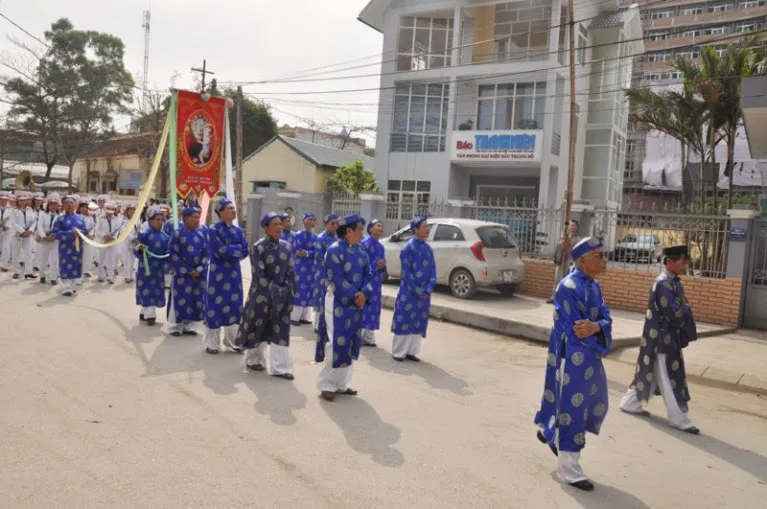
Patron Saint Festivals: Transforming Homes into Festive Altars
Religious feast days in Vietnamese Catholic households transcend simple commemoration; they involve physically transforming living spaces into festive altars dedicated to a particular patron saint. Families may erect temporary displays featuring statues, candles, flowers, and special offerings, effectively creating a domestic shrine that honors the saint’s intercession. This practice reflects a deeply family-centered approach to sanctity, where the boundaries between sacred and domestic blur.
The entire household participates in preparations, cooking special meals, inviting neighbors, and sharing prayers, turning private devotion into communal celebration. Common feast days include the parish patron saint’s day, the feast of the Virgin Mary, and major universal feasts like Christmas and Easter.
The transformation process can be elaborate: families might drape cloths with religious motifs, set up additional tables for food offerings, and arrange photos of deceased family members alongside saint statues, creating a visual dialogue between the heavenly and earthly families. These celebrations often extend beyond the home to the parish church, where communal Masses, processions, and cultural performances take place. The festive atmosphere includes traditional Vietnamese foods, music, and games, making the religious celebration also a cultural gathering.
Such transformations demonstrate how Vietnamese Catholics integrate faith into cultural expressions of hospitality and festivity, embodying the principle that belief should be celebrated joyfully rather than observed somberly. The practice strengthens family bonds and community identity, as shared religious celebration reinforces both Catholic and Vietnamese belonging, embodying Catholic national traditions in Vietnam.
Social Charity and Community Faith: Caritas Vietnam in Action
- Caritas Vietnam: The Church’s official charitable arm coordinates nationwide outreach, providing disaster relief, healthcare assistance, and support for the poor, embodying the Catholic social teaching principle of solidarity. Established in the early 2000s, Caritas Vietnam operates through diocesan offices and parish-based volunteer networks, responding quickly to natural disasters like floods and typhoons that frequently affect the country.
-
Scale of impact: With approximately 7 million Catholics across Vietnam’s 26 dioceses, parish-based charity networks reach remote communities, delivering aid regardless of recipients’ religious affiliation.
Caritas Vietnam reports assisting hundreds of thousands of beneficiaries annually, with programs ranging from emergency relief to long-term development projects like building schools and clean water systems.
- Faith in action: This social outreach translates the “faith as a festival” concept into tangible service, showing that authentic worship must produce concrete love for neighbor, especially the marginalized. Charity work is framed not as optional extras but as essential expressions of Catholic identity, flowing naturally from Eucharistic participation.
- Community mobilization: Movements like the Eucharistic Youth Movement (Thiếu Nhi Thánh Thể) and the Legion of Mary (Legio Mariae) organize volunteers for charitable works, fostering a culture where service is a normal part of Catholic identity. These groups provide structured avenues for lay involvement, training members to serve both within the Church and in broader society.
-
Complementary to devotions: Charity work does not replace prayer but flows from it, creating a holistic Catholic culture where interior devotion and exterior action form an inseparable rhythm.
Many parishes organize charity drives during Lent and Advent, connecting seasonal penance with practical solidarity. This integration ensures that Catholic cultural practices remain relevant to the needs of the wider community.
The most surprising aspect of Vietnamese Catholic cultural practices is how seamlessly ancestor veneration—a cornerstone of traditional Vietnamese culture—finds harmonious expression alongside Catholic worship within the same household altar.
This integration reveals a theological flexibility that many Western Catholics might consider impossible, yet it thrives in Vietnam through careful spatial arrangement and symbolic meaning-making. The dual altar system shows that cultural identity and religious identity can enrich rather than conflict with each other, forming a living heritage of Catholic traditions. For anyone seeking to understand this living faith, the most authentic experience comes during a major feast day when a Vietnamese Catholic family opens their home for celebration.
Witnessing the altar adorned with flowers, the scent of incense mingling with traditional foods, and generations praying together provides a visceral lesson in how faith can become truly enculturated without dilution. To truly appreciate this vibrant tradition, consider visiting a Vietnamese Catholic parish during a feast day or connecting with the CBCV to learn more about these enduring practices.